
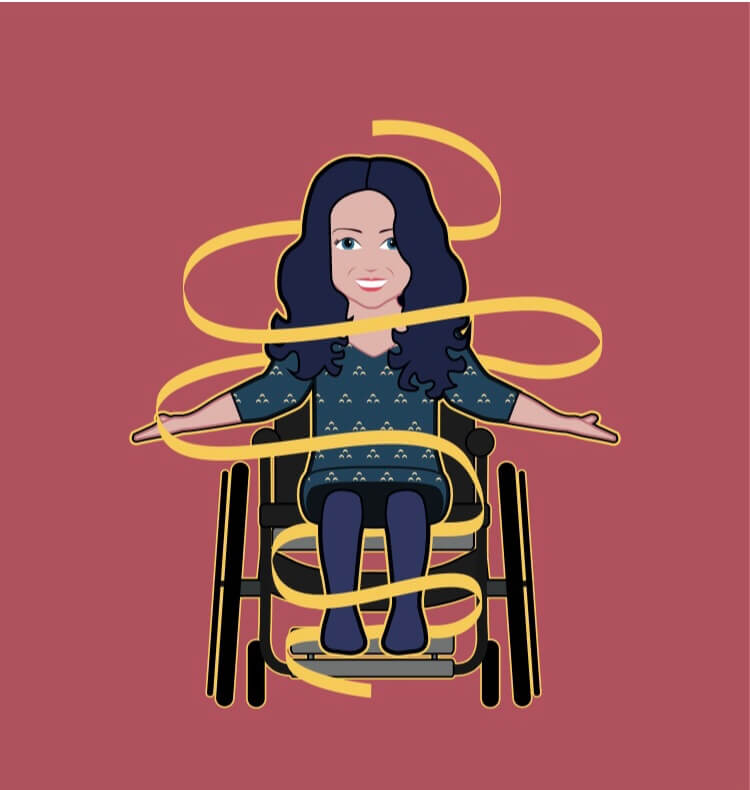
I have always wrestled with the concept of time. I believed that I was always late for everything, late to the party as they say. This coupled with the fact that I regularly arrived late for everything only supported my theory. This idea started early in life. I was born with a disability and so I regularly heard discussions and had discussions with medical professionals and teachers about not hitting certain benchmarks on time or indeed not hitting them at all. I was always “behind” the other kids. I was also behind them academically and often missed chunks of time in school due to ill health or fatigue. At one point it was decided that I stay back a year because I missed so much of one particular school year. This of course added to my “always behind” feeling and really cemented my way of thinking.
I am now a wheelchair user but when I was a kid, I used splints for a little while to help me walk. As I got a little older, I asked my parents if I could please use a wheelchair on a more permanent basis. They had concerns as to whether this was a good idea at first. I don’t have a clear memory of this specific moment but my mom tells me that one day when I was about seven or eight, we were in a department store wandering around and she asked me why I wanted to use the chair more often. I told her that I just wanted to be able to keep up with everyone else. Although I don’t remember this particular conversation, I remember that this was the overall feeling I have always had, especially in childhood. I just want to keep up with everyone else!
As a young adult I took on jobs, schedules and commutes that were demanding on the body. They left me feeling exhausted, sad and guilty that I had no time for a social life or anything else very productive. I felt like I was letting everyone down and that I was something of a failure that I hadn’t hit these benchmarks on time because that is what you are supposed to do to qualify as an adult. There are certain steps you must take in order to be a grown up. There is a timeline you must follow to fit into adulthood.
This notion has also followed me into adulthood. I finished school and went to college later than my peers, I progressed in my career at a slower pace. I looked on while they crossed off other rites of passage like getting married, having kids and buying houses, always feeling like I was lagging behind or missing a step. Feeling if I could just stop time for a little bit, I could find the map that everyone else seemed to have in their possession and then I’d have a chance to catch up.
The journey with my body has been a similar one. I believed that it moved too slowly and took way too much time to get anywhere. I was always trying to overcompensate for my much too slow body with my much too fast brain. They were not going at the same speed and this often caused frustration, panic and anxiety in many areas of my life. I have spoken many times about how MBS has helped me with this. I realized that my body was actually waiting for me and my mind to get on the same page rather than the other way around. This has allowed me to be kinder and more forgiving of myself.
Recently I came across something else that has helped me to challenge this old way of thinking and belief system. In my book club we just read “Detransition, Baby” by Torrey Peters. I won’t go into the book or what it’s about but in it the writer spoke about something called “Queer Temporality”. This is the basic idea that people in the LGBTQ community have a different timeline than that of straight people. I was really interested in this and so I looked into whether the same applied to people with disabilities. It seems it did, and this is called “Crip Time”. Crip Time addresses the notion that people living with a disability or a chronic illness experience time and sometimes space, differently than able bodied people do. Perhaps due to disability we lost time, or it got interrupted because of illness or just the day-to-day hours that are taken up with trying to maintain a body that is disabled and so therefore we don’t follow the same trajectory or perhaps we do but at a different pace.
The writer Srinididhi Raghavan says in her column “Bodies Minds” that she was always deeply conflicted about time wondering if she was wasting it, lying in bed in order to look after her body. She explains that this idea of Crip Time has helped her deal with her grief over the issue. Some have described it as broken time, time when we are forced to take breaks even when we don’t want to. Even when we want to keep going like everyone else. Author Alison Kafer suggests that “rather than bending disabled bodies and minds to meet the clock, Crip time bends the clock to meet disabled bodies and minds.” Personally, I think that sounds like a good plan.
I know this probably won’t fit for everyone who has a disability or chronic illness. I don’t mean it to, again everyone is different. I think I have just always been looking for someone to tell me it wasn’t my fault, that it wasn’t that I got something wrong or missed the directions to the faster route. I guess this theory has helped me to realize that my timeline isn’t off as I’ve always thought, it’s just my timeline and no one else’s. Just like this is my body and no one else’s and it will go at its own pace no matter what I tell it to do, and I have told it to do a lot. I have to factor my disability in and stop pretending that I can outrun it. It’s playing its part and that’s OK.
The author Matt Haig of whom I am a fan wrote a book many years ago called “Reasons to Stay Alive”. In it he writes
“How to stop time: kiss.
How to travel in time: read.
How to escape time: music.
How to feel time: write.
How to release time: breath.”
He also later wrote a book called “How to Stop Time”, so it seems I’m not the only one trying to figure this out. I guess that’s why we need Yoga so we can learn to breathe, ground and stay in our bodies for as long we can, until the clock runs out. Needless to say, I haven’t learned how to stop time yet, but I might be learning to embrace it and the scenic route that this life and body has taken me on. It mightn’t be very quick but it sure is pretty and I’m learning, little by little, day by day, to enjoy the view.